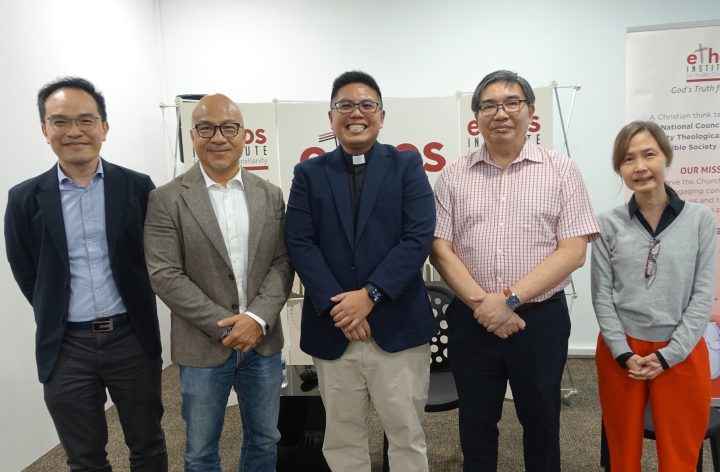
How do we navigate our way to the Common Good in an evolving democratic landscape?
On 21 March 2025, the ETHOS Institute for Public Christianity successfully hosted the ETHOS Annual Conversation 2025 at the Bible House in collaboration with The Bible Society of Singapore, bringing together scholars, theologians, and members of the public to engage in critical discourse on the intersection of faith, democracy, and the common good.
This year’s conversation, themed Democracy and the Common Good, provided a platform for participants to build meaningful connections within the theological community through the theological dimensions of this mission.
The event featured distinguished speakers, Professor Joseph Liow, the Dean of the College of Humanities, Arts, and Social Sciences at Nanyang Technological University (NTU), and Reverend Jeremy Joe Tan, an ordained minister with the Anglican Diocese of Singapore.
Both explored the relationship between democracy and the common good from their respective fields of democracy’s historical and ethical foundations and theology that framed democracy not just as a political system but as a moral commitment to building a just and caring society.
DEMOCRACY AND THE COMMON GOOD
Professor Joseph Liao of Nanyang Technological University (NTU), a distinguished speaker at the event, commenced the discussion by tracing the origins of democracy, noting its Greek and Roman foundations. He highlighted the fundamentals of democracy’s derivation: demos meaning people and kratos meaning power, which translates to the distribution of power among people.
He posed a thought-provoking question: Can democracy and Christianity coexist?
His speech emphasised the importance of a relational approach to democracy, one that aligns with Christ’s teachings by prioritising the greater good, an inherent obligation to care for others based on shared interests, such as public infrastructure, law enforcement, and education—contrasting a mere cost-benefit mindset driven by individualistic interests. At the heart of his message was the belief that democracy should be anchored in God’s sovereignty, guiding a nation’s progress toward a collective good rather than mere transactional outcomes.
“Christ’s ministry was not transactional but sacrificial, driven by obedience and love.”
In his speech, Professor Liao elaborated on the challenges of evolving democracy through the lens of the historical normalisation of slavery in the United States due to the lack of moral and ethical grounding. He explained that democracy thrives when rooted in the virtues of Christ’s teachings.
As stated in the Colossians 3:23-24, working “as for the Lord and not for men” carries significant implications for how we approach our roles as citizens, leaders, and members of a democratic society.
“The common good is peace, as defined by God’s law; which is a path to eternal life; which is ultimately the city of God.”
We cannot solely rely on the State to care for the needy; we are called to be His hands and feet, extending love and service to our communities.
CHRISTIANS CALL TO SERVE
Genesis 2:18 says, “It is not good that the man should be alone; I will make him a helper fit for him”, speaking to the fundamental human need for mutual support which extends to the broader idea of community and governance.
Professor Liao concluded his lecture with the phrase “the Unity of God’s People and the Unity of Humanity”, explaining that following the principle ensured that governance was guided not just by majority rule, but wisdom, ethical principles, and mutual care.
“The Kingdom of God is not a democracy, but Christians have a duty to shape democracy towards His Kingdom.”
Streams of Life is a media partner of The Bible Society of Singapore.