One Million Meals Supplied!


Alliance of Guest Workers Outreach (AGWO) announces milestone deliveries of 1 million Care Meals, and enhanced assistance for guest workers in partnership with MOM and MWC

SINGAPORE — The Alliance of Guest Workers Outreach (AGWO)—a movement of Hope Initiative Alliance (HIA), and a coalition of more than 130 partnering charities and organisations—has effectively delivered more than 1,000,000 Care Meals from 10 April to date. These efforts, in collaboration with our core partners, Ministry of Manpower (MOM) and Migrant Workers’ Centre (MWC), have provided food (1m), fruits and dry rations (906k), hygiene products (154k), masks and sanitisers (144k) medical supplies (2.5k) and even breakfast items during the Ramadan period, throughout the Circuit Breaker period to 301 Factory Converted Dorms (FCDs) as well as during Phase 1 and 2.

In addition to regularly providing Care Meals, the AGWO organised the Festive Care Packs @ Vesak/Ramadan initiative, as well as the Hari Raya Festive Pack initiative, as additional segments. Being an interracial and interreligious Non-Profit Organisation, the AGWO is committed to meeting the needs of all workers across varying backgrounds.

The AGWO is especially thankful for its partnership with MWC and MOM that have allowed for access into Factory-Converted Dormitories, as well as support in ensuring deliveries were distributed in manners that observed safe distancing measures, for the safety of all participants involved.

Other partners through the course of distribution have included the Singapore Press Holdings’ Chinese Media Group (CMG), National Volunteer and Philanthropy Centre (NVPC), Inter-Religious Organisation, Singapore, and Singapore Buddhist Federation. The various initiatives were also launched in the spirit of SG Cares, SG United and Singapore Kindness Movement.

Care Packs that had been distributed included meals for the guest workers, as well as the following: Category 1 [Fruits]: Fresh and dried fruits (i.e. apples, bananas and dates), Category 2 [Dried Rations]: Bread, biscuits, snacks, coffee and milo sachets, Category 3 [Medical Supplies]: Vitamin supplements and medical kits, and Category 4 [Hygiene Products]: Surgical masks, hand sanitisers, soaps, toothpaste and toothbrushes).

Reiterating the support of many Members of Parliaments and Ministers who had come alongside the AGWO in distribution efforts, Tan Chuan-Jin, Speaker of Parliament—who frequently volunteered with distribution efforts—affirmed the collective efforts of the AGWO and partnering organisations through an official statement.

“It is certainly heartening to see Singaporeans coming together to support our guest workers through such community ground-up initiatives. This project among others by Hope Initiative Alliance illustrates the impact we can make when we rally together, as one united Singapore, to uplift the various vulnerable members of our society. It is my hope that more of us will continue to support such efforts and work together through this trying period.”

Ms Denise Phua, Mayor of Central CDC, Ms Joan Pereira, Member of Parliament for Tanjong Pagar GRC, and Mr Yeo Guat Kwang, Chairman of MWC, also participated in the distribution efforts on 7 May, alongside volunteers and individuals from partnering organisations.

While the AGWO continues efforts to care for guest workers, the priority of Phase 2 would be to work collaboratively with MOM and MWC to encourage employers to take increased ownership and responsibly care for their workers, amidst the COVID-19 pandemic. In order to supplement these efforts and sustainably meet the needs of 6,000 workers whom we have committed to caring for amidst Phase 2, the AGWO will continue its efforts to raise funds, as well as donations in kind for the items mentioned above.

New initiatives, in collaboration with MOM and JTC, will include bridging gaps in legal, counselling and medical assistance, together with partners such as SATA CommHealth and Healthserve. Other initiatives in the pipeline include community integration programmes, skills advancement courses, and culturally-relevant entertainment avenues and sports activities.

As we strive to cater to the needs for the guest worker community amidst Phase 2 and beyond, the coalition is also recruiting volunteers to serve as administrative staff, and other capacities. If members of the public should wish to register as volunteers, they may do so at hia.sg/volunteers.

More information about the initiative may be found at hia.sg/guestworkers. For enquiries, email covid19@hia.sg.

For individuals who wish to support future projects of HIA and/or AGWO, kindly contact Mr Aaron Fun at aaron.fun@hia.sg.

ABOUT THE ALLIANCE OF GUEST WORKERS OUTREACH

The Alliance of Guest Workers Outreach (AGWO) aims to provide guest workers in Singapore with holistic care in a sustainable manner by establishing a national platform for collaborations, partnerships, and the sharing of resources and services that are targeted at improving their working and living experiences.

AGWO is an initiative of the Hope Initiative Alliance (HIA), in partnership with various Voluntary Welfare Organisations (VWOs), civil organisations, corporations, professional bodies, guest worker dormitories, and government agencies.

ABOUT HOPE INITIATIVE ALLIANCE

slot gacor maxwin malam ini

Hope Initiative Alliance (HIA) is a collective of multiple charities and non-profit organisations in the region that aims to support and bring hope to the poor, deprived, and marginalised communities in Singapore and beyond.

Open Letter to the Church On World Refugee Day 2020


Stand Up, Speak Out, and Take Action

Few would disagree that the world is not as it should be. It feels like we are on a mutinous ship sailing off course into a hurricane in a war zone. And as much as we would like to focus on solving one crisis at a time, we have little choice but to deal with them all at the same time.

Among the challenges we need to keep on our radar is the escalating global refugee crisis. As is true for other great challenges of the 21st Century, the Church has potential to be an important part of the solution if she will dare stand up, speak out and take action.

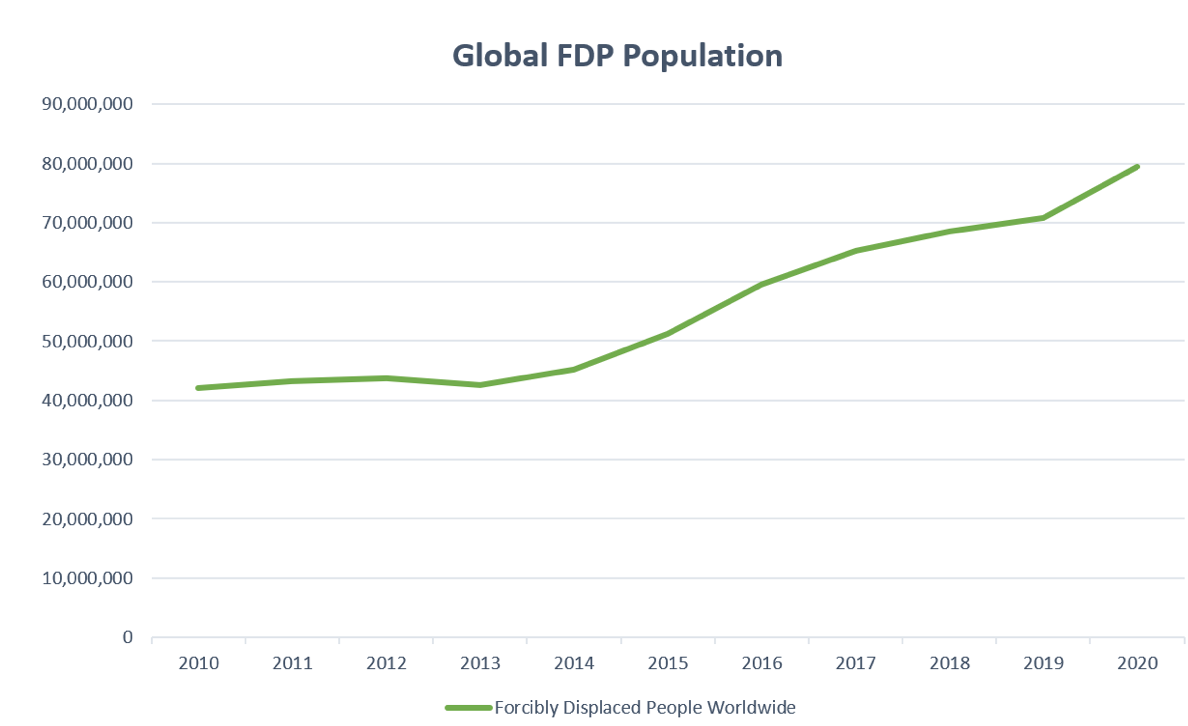
Table 1: In the past 10 years, the number of forcibly displaced people has doubled to nearly 80 million worldwide. (Statistics from UNHCR Global Trends. Statistics are taken from the annual Global Trend issues released between 2010 -2020. Global Trends is available from www.unhcr.org.)

World Refugee Day is observed annually on June 20th to help us not lose sight of the escalating number of displaced people worldwide who have been forced to flee their homes due to persecution, war, and gross violations of human rights. We call these women, children and men, “refugees”, “asylum seekers” and “internally displaced people” (IDP). One person in every 97 people is forcibly displaced today. (UNHCR, Global Trends 2019, published in June 2020.) They are among the most marginalised and vulnerable people in the world.

The majority are women and children. Although each person’s experience is unique, they have this in common: they fled their homes because they feared for their lives and they cannot safely return. (Learn more at www.IAFR.org/learn and www.IAFR.org/toolbox.)

A tiny fraction of the refugee population is given opportunity to integrate into their country of refuge or to resettle to another country in which they can begin to rebuild their lives. Most languish in camps, detention centres, government housing, or on the streets for years and even decades as they wait on a solution to their displacement. Life in such conditions is nothing short of dehumanising.

“I wake up every morning and have to remind myself
that I’m human.”
(From a conversation I had with a Somali man in Kakuma refugee camp, Kenya.)

The world has identified three solutions to forced displacement, each of which deals with restoring place to people.

  1. Return home.
  2. Integrate into your country of refuge.
  3. Resettle to another country.

On the face of it, these should work. But they are failing miserably. They fail not because they are bad solutions. They fail because our world lacks the will to implement them in any meaningful way.

For how can a refugee return home if the conditions that forced her to flee have not been resolved? And how can a person integrate into her country of refuge when 85% of the world’s refugees are in developing nations that do not have the economic or social capacity to absorb so many people? And how can they resettle to another country when nations are increasingly reluctant to offer them opportunity to do so?

Not only are the solutions failing, some nations that could be helping are avidly pursuing unjust and harmful “solutions”. Some have mobilised their military to stop refugees from entering. Some are erecting fences and building walls to keep them out. Some have created policies of deterrence – purposely creating inhumane conditions for asylum seekers and refugees within their borders. Some have even developed policies to offshore asylum seekers – sending them to wait in another country while their case is processed (including Libya, Rwanda, Mexico, Papua New Guinea, and others). Governments pursuing these kinds of “solutions” are prone to misrepresent refugees and asylum seekers, framing them as a threat to their society rather than as people in desperate need of safety.

Such responses only serve to increase suffering, violate human rights, and contribute nothing helpful to the pressing need for solutions to forced displacement in our world.

So as the number of forcibly displaced people in the world rises, the space in which they can seek refuge is shrinking. This increases the uncertainty, vulnerability, and hopelessness with which displaced people wrestle daily. Where can they find hope for a solution to their suffering and loss of place?

“Faithful Christian ministry will often take Jesus’ followers to places where hope is in short supply: places where a sense of hopelessness hangs over a community.”
(The New Testament In It’s World, by NT Wright and Michael F. Bird, page 888. Publisher: Zondervan Academic, 11/2019.)

While it is troubling to see some Christian leaders and churches supporting anti-refugee and anti-asylum seeker policies, there are a growing number of others advocating on behalf of forcibly displaced people and actively welcoming and serving them. They rightly believe this to be an essential part of the mission with which God has entrusted us.

We shouldn’t overlook the fact that human migration was part of God’s plan from the beginning when he commanded humankind to “be fruitful and multiply, and fill the earth”. (Genesis 1:28) Following our rebellion against God and our subsequent deportation from the Garden, human migration plays an important backdrop to much of the biblical narrative. Many are the stories of forced migration in Scripture. (Download “Refugees in the Bible” for a listing of many forcibly displaced people in the Bible. Available at www.IAFR.org/toolbox.)

Furthermore, the Bible is filled with verses communicating God’s expectation that his people seek the welfare of the vulnerable – including the oft repeated trio of the fatherless, the widow and the foreigner. What foreigner is most like the orphan and the widow if not the refugee?

cempakaslot deposit 10rb

To be absolutely sure that we don’t miss the importance of this, God flat out commands us to love the alien as we love ourselves (Leviticus 19:34) and to welcome strangers (Matthew 25:35). For this is how the kingdom of God works itself into our turbulent world.

Fear of refugees and asylum seekers cannot advance the kingdom of God.

The kingdom comes when we let go of fear and embrace love. It comes into view when we choose to no longer view refugees and asylum seekers as a threat to be stopped, but rather recognise them to be people in need of our welcome and protection.

Imagine if the majority of churches worldwide actively joined their voices to others in the world calling upon our nations to actively welcome, protect and integrate forcibly displaced people into our societies rather than spending millions to keep them outside of our borders. We just might be able to influence public opinion and awaken the will of our governments to meaningfully implement solutions to forced displacement.

Churches can do more than advocate for place on behalf of refugees and asylum seekers. For what local community is better suited to helping people survive and recover from forced displacement than a church? At her best, a local church is a supportive, welcoming, and healing community that offers life-giving faith in the God who sees, hears, and cares for us. We are to be communities that reflect the image of God to others – especially to the marginalised and vulnerable in the world.

A healthy church turns outsiders into insiders. Local churches have the holy privilege of offering place to others that sends the powerful message: “You belong here. You are one of us.” It is impossible to overstate the profound impact this has on a person who has been stripped of their place in the world.

The Church has a critical and unique role to play when it comes to engaging the global refugee crisis. She can do what humanitarian agencies and social services cannot. The Church can rehumanise refugees and asylum seekers while helping them integrate into their new context. Such work is central to our mission and plays to the natural strengths of a healthy church.

As we sail on deeper into the turbulent 21st Century, may the Church stand up as a beacon of hope as it plays an active part in the implementation of solutions to the benefit of those who have been stripped of place in the world.

“Spend yourselves in behalf of the hungry
and satisfy the needs of the oppressed,
then your light will rise in the darkness,
and your night will become as noonday.”
Isaiah 58:10


For more resources:

  1. www.IAFR.org/learn
  2. www.IAFR.org/toolbox


Tom Albinson has been serving internationally as a missionary among refugees since 1981. He serves as Founder/President of International Association for Refugees (IAFR) and as Ambassador for Refugees, Displaced and Stateless People with World Evangelical Alliance (WEA). He is a founding member of the Refugee Highway Partnership (RHP).

Bible Mission Update 2020


The Mission of the Bible Society of Singapore (BSS) is to make God’s word known to all peoples—by making it available through translation and publishing, available through distribution and literacy, and credible through engagement and advocacy. The BSS corporate video will display how in spite of the challenges posed by the COVID-19 pandemic, BSS has striven to support Christian communities in their ministries, and continues to work with government and non-profit organisations to serve the most vulnerable among us.

slot gacor maxwin malam ini

7 Churches in the Book of Revelation


Join us on this 10D7N Bible Land Tour to Turkey which is a great combination of pilgrimage + sightseeing and experience what the early Christians went through. You will visit some of the most important Christian sites including the Seven Churches of Revelations (Smyrna, Ephesus, Thyatira, Pergamon, Sardis, Philadelphia and Laodicea).

Have a lovely experience in Cappadocia where you will have an opportunity to ride the hot-air balloon (optional at own cost) and see the beautiful panoramic view of the famous rock formations. Also explore the major sights in Istanbul including Hagia Sophia and take the Bosphorus cruise to enjoy the unique experience of cruising between 2 continents, Asia and Europe.

It will be a wonderful pilgrimage and you be inspired as you see the history of the Early Church come alive.

Tour Highlights:
Thyteria, Pergamon*, Smyrna, Ephesus, Sardis, Philadelphia, Laodicea*, Hierapolis*, Pamukkale (Cotton Castles), Cappadocia, Goreme Open Air Museum*, Kaymakli Underground City*, Hagia Sophia, Bosphorus Cruise and more.

*Indicates that the site has uneven or steep path(s) that may be challenging for elderly and people with walking difficulties. For such participants, you are advised to use a walking stick.

slot online

READ MORE: https://www.bible.org.sg/turkey-8-17-june-2020/

Festive Care Packs for Vesak Day and Ramadan


Given that Vesak Day and Ramadan fell within the circuit breaker period, the Alliance of Guest Workers Outreach (AGWO) – a movement of Hope Initiative Alliance – and its partnering organisations, donors and volunteers came together to care for guest workers commemorating these occasions, by providing them with Festive Care Packs. This project – which supplemented the regular Care Meals distribution – sought to provide 12,000 guest workers with Care Packs across 260 dormitories. The Care Packs included fruits, dried ration items, medical supplies, hygiene products, and a lot more.

On 5 and 7 May 2020, nearly 300 volunteers – consisting of packers and drivers – came down to the collection points – Bible House at 7 Armenian Street, as well as Sower Hub at TSL 101 – to help distribute the Festive Care Packs nationwide. We were greatly encouraged by the participation of the Speaker of Parliament, Mr Tan Chuan-Jin; MP of Tanjong Pagar GRC, Ms Joan Pereira; Mayor of Central Singapore District, Ms Denise Phua; Chairman of Migrant Workers’ Centre (MWC), Mr Yeo Guat Kwang; General Secretary of the Singapore Kindness Movement, Dr William Wan; and Bishop Terry Kee, President of the National Council of Churches of Singapore. We are also grateful for the partnership of the National Volunteer and Philanthropy Centre, Inter-Religious Organisation, Singapore, and Singapore Buddhist Federation in this exercise.

“It is certainly heartening to see Singaporeans coming together to support our guest workers through such community ground-up initiatives. It is my hope that more of us will continue to support such efforts and work together through this trying period.” — Mr Tan Chuan-Jin, Speaker of Parliament

“The migrant workers are doing their part by heeding the measures of the government. What we can do is come together to make their lives happier by distributing food, hand sanitisers, and medical supplies to them. Everybody is in this together.” — Ms Joan Pereira, Member of Parliament for Tanjong Pagar GRC

“Our actions will always speak louder than words, and put together—regardless of our language, race or religion, or background—this is the right thing to do. We can only overcome this difficult time if we do it together… taking action, dirtying our hands, giving up money and resources wherever possible, to make things better.” — Ms Denise Phua, Mayor of Central CDC

“At a point of time when people feel most forgotten and uncared for—is exactly when it is vital that we remind them that we are a community. Only when we are united in our efforts, can we overcome this global pandemic and its repercussions.” — Rev Ezekiel Tan, President of Hope Initiative Alliance

“We are glad to have partnered HIA/AGWO, together with several supporting organisations to celebrate Vesak and Ramadan with our migrant brothers and sisters who are residing in the factory converted dormitories. Jointly, we have…showed care and reminded our migrant friends to continue to practice personal hygiene to protect themselves.” — Mr Yeo Guat Kwang, Chairman of MWC

“Through our actions, we are loving our neighbours as ourselves. It is also a wonderful opportunity for churches to work together as one, in cooperation with those of other faiths—demonstrating how we can work for the common good of Singapore.” — Bishop Terry Kee, President of the National Council of Churches of Singapore

On 23 and 24 May 2020, the initiative also conducted two special deliveries to about 7,000 guest workers from over 110 factory-converted dormitories, in commemoration of Hari Raya Puasa. Other than the regular Care Meals, both Muslim and non-Muslim guest workers received extra packs of other foodstuffs, enhanced meals – three times the usual value – as well as new sarongs and extra snacks. The Speaker of Parliament, Mr Tan Chuan-Jin joined the distribution efforts as the Guest of Honour. We are thankful for the partnership of MWC, Majlis Ugama Islam Singapura (MUIS), Inter-Religious Organisation, Singapore (IRO), and Singapore Bangladesh Society. 

We are also grateful for the embassies of Sri Lanka, Bangladesh and Saudi Arabia, who also helped raise support and contributed donation items. 

PARTNERS

bonus slot cempakaslot

  • National Volunteer and Philanthropy Centre 
  • Inter-Religious Organisation, Singapore 
  • Singapore Buddhist Federation 
  • Ministry of Manpower 
  • Migrant Workers’ Centre  
  • Majlis Ugama Islam Singapura  
  • Singapore Bangladesh Society 
  • Bangladesh High Commission, Singapore 
  • Sri Lanka High Commission in Singapore 
  • Royal Embassy of Saudi Arabia, Singapore 

7 Days in the Desert as in the Time of...


Survive, Live and Love

Leave your comfort zone and experience a time without telephone, without clock and without internet!

Date: 19-26 May 2020

Tent camp with campfire in the biblical Negev desert.

Come and learn survival tips for the wilderness: navigation and orientation. Edible Wüstenpflanzen. Creative art of escape and survival. How to produce water in the desert. Our teachers are wolves, tigers, plants, Abraham, King David, an Israeli desert command and more …

Survival tips and methods that shape our human behaviour in a new way, be it private life, career, faith or inner peace. Recharge your batteries and experience the closeness of the living God in the midst of the desert! Come into harmony with the Creator and time in a completely new way!

From the program:

– Hikes into the fascinatingly beautiful desert landscape where you will encounter desert animals and unexpected vegetation, because the desert is alive and offers more than just sand, stones and thorny bushes.
– Cooking and baking in the sand – just as it is common in the desert.
– Learn about the survival techniques of the Bedouins and from biblical times.
– Group dynamic workshops, jogging in the morning or evening.
– A Shabbat celebration under a starry sky.
– Spiritual dialogues & inputs, time for silence in the shade of acacia trees.
– We let the evening end comfortably and watch like Abraham the countless glittering stars under a clear desert sky!
– Overnight stays in 2-person tents, full board, parent tent in the middle of the camp, water and shower.
– Local English guide.
-Limited to 30pax only

——————–

*Do note
a. There is a screening process after registration. A confirmation email to join the tour will be emailed to you once the screening details are approved.

b. This is not your usual tour. This is a desert experience hiking trip. Participants will be camping out in the desert. Simple meals will be prepared during the hike and some meal preparations will required the assistance of participants to help out.

c. The itinerary is subject to changes due to weather or logistical reasons.

———————

Tour cost: SGD$3, 150 (exclude air-ticket)

*Do note:
– The tour requires a minimum of 20pax for the tour to materialise.
-Please do not purchase your air ticket until you have received a notification email from us to do so.
-IBEx reserves the right to cancel the trip up to 60 days prior to the departure if the group size is not reached.

Cost includes :
– Professional hiking program in Negev Desert
– Outdoor camping or desert camps (Tents and mattress will be provided. A tent to 2 pax)
– Meals included: Breakfast, light lunch, dinner (Al-fresco style)
– Local English-speaking guide
– Bus transportation where necessary
– Water container
– First aid equipment
– Evening camp fires – Air tickets

Cost excludes: 

– Travel insurance
– Visa application fee if required
– Tips to guide, driver, camp team
– Any pre or post trip personal extensions
– Any airport transfers to the meeting point or to your return point of destination
– Any personal expenses

——————–
Payment Information:

Deposit: $1k upon registration
Balance payment: 2 March 2020

——————–

daftar slot cempakaslot

Here the complete program for the camp in the desert:

Day 1: 19 May
Departure from the meeting point in TLV. With jeeps into the desert to the tent camp. Welcome, dinner and first meeting at the campfire.

Day 2: 20 May
6:00 Silent Time & Morning Meditation.
7:30 Breakfast.
10:00 Desert & orientation.
13:00 Lunch. Heat, Silence, Break & Program.
17:00 Workshop: Survival skills in the desert. What value does time in the desert have?
19:00 Dinner & dialogue around the campfire with Aviel & Anat Schneider

Day 3: 21 May
6:00 Silent Time & Morning Meditation.
06:30 Breakfast.
7:00 Desert hike (optional) in a radius of ten kilometers around the camp. How alive is the desert? Return in the afternoon. (Those staying in camp: workshop on cooking in the desert)
17:00 Silent time & meditation.
19:00 Dinner & campfire. News about darkness, night, stars and moon in the desert.

Day4: 22 May
6:00 Silent time & morning meditation.
7:30 Breakfast.
10:00 Dialogue round: How important is our own initiative in daily life?
13:00 Lunch. Heat, silence, break & program.
17:00 Workshop: Surviving the desert with own ideas and initiatives. How to find the North? Water and food in the desert?
19:00 Dinner & campfire. How do we get along at night in the desert? What are the advantages of darkness?

Day 5: 23 May
6:00 Silent time & morning meditation.
06:30 Breakfast.
07:00 II. Desert hike (optional) in a radius of ten kilometres around the camp. How do you get around the desert on the way? New tips. Return in the afternoon. (Those staying in camp: workshop on Shabbat and the Bible)
17:00 Silent time & meditation & preparation for Shabbat meal.
7:00 pm: Together we celebrate the Shabbat meal in the desert according to biblical tradition. Under the open starry sky and our Israeli friends. Midrash from the Bible with Aviel & Anat Schneider.

Day 6: 24 May
6:00 Silent Time & Morning Meditation.
7:30 Breakfast.
10:00 Dialogue and Training: To what extent are we resilient under extreme conditions?
13:00 Lunch. Heat, silence, break & program.
17:00 Round of talks with Aviel & Anat Schneider.
19:00 Dinner & Campfire. Talk about fear, loneliness and peace with God.

Day 7: 25 May
6:00 Silence time & morning meditation.
7:30 Breakfast.
10:00 Workshop: Biblical figures and my life.
13:00 Lunch. Heat, silence, break & program.
17:00 Silence time & meditation on the last afternoon until dusk.
19:00 Dinner & campfire. Dialogue round desert and me.

Day 8: 26 May
6:00 Silent time & morning meditation.
7:30 Breakfast.
10:00 Shalom & Goodbye. We leave the desert. Departure to TLV.
We invite you to join us and experience 7 unforgettable days as if transported to another time – call us today for this!

This training and the stay in the desert will leave lasting, unforgettable impressions for every participant! You can gain valuable experiences that will also be useful in your daily life.

This “Survival Desert Camp” is unique – join in!

For more information or to register, contact us at 6304 3762 or info@ibex.sg.

It Takes a Church


“It takes a village to raise a child.” This African proverb, the origin of which remains a mystery, has become widely known and loved. Its broad appeal is no doubt due to the fact that it rings true, that is, it conveys an earthy wisdom that contemporary society finds uncommonly refreshing and challenging.

Equally true is the proposition that it takes the Church to raise a godly child.

From its earliest beginnings, the Church has understood the important role that it—as a Christian community—plays in the nurture of children. This is instantiated in a number of practices that are an inseparable part of the Church’s liturgical and communal life: infant baptism, children’s catechism, children’s communion, etc.

These practices reveal the way in which the Church, shaped by the teachings of Scripture, regards children. Unlike the Greco–Roman society of the second century that often deemed children as mere property, the early Christians saw them as bearers of the divine image (Gen 1:26–28) and therefore as possessing an inviolable dignity.

rtp slot cempakaslot

Unlike many cultures and societies (both past and present) where children are valued only for their future contribution as adults, Christians, following their Lord (Matt 18:3), value them as children. Reflecting on the radicalness of Jesus’ attitude towards children, Dawn Devries notes that: “[Jesus] not only [welcomed] but [set] them up as models to be emulated. The value of these children, according to Jesus, is not for the sake of something else but simply for what they are in themselves as children: that is, Jesus holds childhood as intrinsically valuable.”

Like adults, children have a special place in the Body of Christ. And, like the adults, children too must undergo spiritual formation. Dallas Willard defines spiritual formation in Christ as “the process whereby the inmost being of the individual (the heart, will or spirit) takes on the quality of Christ Himself.”

For many Christians, the first thing that usually comes to mind with regard to the spiritual nurture of children is the ministry of the Sunday School. However, the spiritual formation of children must also be seen as taking place beyond the confines of the Sunday School, that is, beyond the catechetical aspects of Church life—indispensable though this is.

For the Church is not fundamentally a school but a community, a koinonia, a fellowship of people gathered in the name of Christ and energised by the Holy Spirit.

It is through the dynamics of koinonia—often informal, spontaneous, unrehearsed, unpredictable and messy—that Christians learn what it means to be Christ’s disciples, what it means to pray, to carry each other’s burdens, to love, to forgive, to endure, to edify and to worship.

And it is also in and through this community that children learn what it means to live before God (Coram Deo) and for others.

What this means is that every member of the Body of Christ—not just their biological parents—must bear the responsibility for the spiritual wellbeing of the children in the congregation.

This truth is beautifully and movingly underscored in the baptismal rite of the Methodist Church. The pastor asks the parents of the infant baptizands and their sponsors this question:

Will you nurture these children
in Christ’s holy Church,
that by your teaching and example they may be guided
to accept God’s grace for themselves,
to profess their faith openly,
and to lead a Christian life?

After an affirmative response from them, the pastor then turns to the whole congregation and asks: “Will you nurture one another in the Christian faith and life and include these persons before you in your care?” The congregation responds with this covenantal pledge:

With God’s help we will proclaim the good news
and live according to the example of Christ.
We will surround these persons
with a community of love and forgiveness,
that they may grow in their trust of God,
and be found faithful in their service to others.
We will pray for them,
that they may be true disciples
who walk in the way that leads to life.

Abiding in the True Vine


Abiding in Christ is a familiar theme to Christians. Jesus tells his disciples in John 15:5, “I am the vine; you are the branches. Whoever abides in me and I in him, he it is that bears much fruit, for apart from me you can do nothing.”

Interpreters typically draw on viticulture to explain what abiding in Christ means and how doing so results in fruitfulness. What tends to be overlooked is the context introduced by Jesus’ allusion to the Old Testament in John 15:1, “I am the true vine, and my Father is the vinedresser.”

In the Old Testament, the vine or vineyard is a symbol for Israel (e.g., Jer 2:21; Ezek 19:10-14; Hos 10:1) and the vineyard owner, Yahweh the God of Israel (e.g., Ps 80:8-16; Jer 12:10-13; Ezek 15:1-8, 17:5-10). Two passages in the book of Isaiah seem especially relevant to appreciating the vine imagery in John 15:1-8.

In Isa 5:1-7 the vineyard owner does everything a vinedresser would do to cultivate good fruit, but the vineyard produces only bad fruit (vv. 1-4). The owner announces judgment on the vineyard, depriving it of protection and cultivation (vv. 5-6). Verse 7 explains that the LORD of hosts is the owner; Israel and Judah are the vineyard. The LORD expects justice and righteousness of his people, only to find bloodshed and an outcry.

Historically, the LORD’s judgment did fall on his vineyard, most evidently in the destruction of Jerusalem and the Babylonian exile in 586 B.C. However, judgment is not the final word, neither in history nor in Scripture.

Isaiah 27:2-6 shares the imagery of Isa 5:1-7 but reverses its message of judgment. The LORD now watches over and waters the vineyard continually (27:3). He is no longer angry with the vineyard; instead of subjecting it to briers and thorns, the LORD fights against them (v. 4). Instead of producing bad fruit, Israel the vineyard will take root, blossom and fill the whole world with fruit (v. 6).

The vine, vinedresser and fruitfulness motifs intersect in both Isa 5:1-7, 27:2-6 and John 15:1-8. This, along with John’s use of the Old Testament and the wider Old Testament vine imagery, calls for the vine language of John 15 to be understood as an allusion to the Old Testament, not just as a horticultural metaphor. Sensitivity to this allusion informs and enriches the interpretation of John 15:1-8 in three ways.

First, Jesus’ claim to be the true vine (John 15:1) not only recalls but redefines the Old Testament symbol for the people of God. Most significantly, now Jesus, not Israel, is the vine. Moreover, unlike Israel, Jesus is true to the vine’s purpose, that of producing the fruit that the vinedresser expects (see Isa 5:7).

It follows that one must be part of the true vine to belong to the people of God. And because the true vine will not fail to produce fruit, all who are in the vine partake of its fruitfulness. Abiding in Christ is, as such, a response to the person and work of the true vine, not so much a rigour involving this or that spiritual discipline.

Second, the Old Testament allusion guides our understanding of the vinedresser’s role. In John 15:2 the vinedresser “takes away” (e.g., ESV, NASB) or “cuts off” (e.g., NIV) the fruitless branch. Because this branch is “in” the true vine, some object to viewing the removal negatively, proposing instead to translate the verb differently (e.g., “lifts up”) or to stress the ultimately positive purpose of the action.

The allusion to the vineyard owner points in a different direction. The vineyard owner both cultivates (Isa 5:1-2, 27:3-4) and judges (Isa 5:5-6) the vineyard (see also, e.g., Ps 80:8-13; Ezek 17:5-10). This background prepares Jesus’ audience for a vinedresser who not only prunes for fruitfulness but cuts off for fruitlessness. It also makes room for the language of judgment in John 15:6.

While it does not remove the ambiguity in the text, the allusion sets the stage for holding in tension two opposing attributes of the vinedresser. In the light of the character of the vinedresser and the nature of the true vine, abiding in Christ must be seen as a necessity, not a negotiable, for believers.

Third, fruitfulness in Isaiah illuminates the same motif in John 15:1-8. Fruitfulness in John 15 has been variously understood in terms of character, converts, love or obedience, for example. The Old Testament allusion here does not specify one fruit or the other for John’s reader. Instead, it points to covenant faithfulness as the crux of the matter.

In Isa 5:7 the LORD looks for mišpāṭ (justice), only to find miśpāḥ (bloodshed); he looks for edāqāh (righteousness), only to find eʿāqāh (outcry). This memorable play on words affirms that Israel is judged not for being fruitless but for producing the bad fruit of covenant unfaithfulness (Isa 5:2, 4).

The contrast between good and bad fruit (Isa 5:7b) warns believers of obeisance that only resembles obedience. Since it is Jesus the true vine who keeps covenant perfectly and bears good fruit, abiding in him is the only means by which the branches can share in faithfulness and fruitfulness. This also appears to be how worldwide fruitfulness (Isa 27:6) will finally be realised.

Relying on viticulture alone to explain abiding in Christ leads to reductionistic interpretation. The vine, for instance, merely symbolises the source of fruitfulness. Fruit denotes a particular outcome. Or, what one does to “abide” is emphasised over what has already been done “in Christ.”

Attention to biblical allusion does not replace exegesis. It should not be overlooked, however, since allusions form part of a text’s literary-theological context. In John 15:1-8 Jesus’ allusion highlights both continuity (vinedresser’s role; fruit’s nature) and discontinuity (the true vine’s identity and fruitfulness) with the Old Testament vine imagery.

This literary-theological context guides readers to see abiding in Christ as a response to the true vine, not a rigour; a necessity for all believers, not a negotiable; and as bearing the fruit of obedience, not obeisance.

cempakaslot login


Dr Yee Chin Hong teaches Old Testament at Trinity Theological College. Before joining TTC in January 2020, he was on the staff of Cru Singapore (1994-2019), serving in various capacities, including student ministry, teaching, training and short-term missions. From 2016 to 2019, he taught Old Testament at East Asia School of Theology.